🔣 Block States
Introduction
In Minecraft, every block can have one or more block states. For example, logs have different orientations (axis=x/y/z), and leaves can detect their "distance" from a tree (distance=1~7). These states collectively determine the block's appearance and physical behavior.
In CraftEngine, we need to distinguish two core concepts:
🎨 Visual Block State (what the client sees)
This is what players actually see on the client side, also called the vanilla block state.
- The plugin attaches custom models to specific vanilla states (e.g., a particular note block) to achieve unique block rendering.
- In short: visual state = "what it looks like"
⚙️ Internal Block State (what the server computes)
This is what is actually stored and processed on the server side, also called the server-side block state.
- It handles all block logic and physics — collision boxes, redstone signals, entity interactions, etc.
- The server "maps" the internal state to a visual state via specific network protocols and sends it to the client for rendering.
- In short: internal state = "how it actually works"
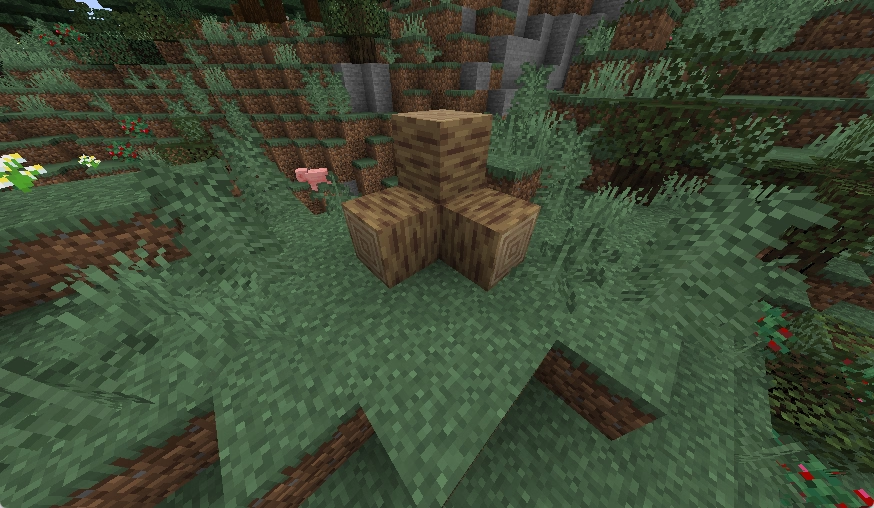
The state/states config section does one thing: assigns each internal block state a visual appearance for the client.
Depending on block complexity, there are two modes:
| Mode | Config key | Use case |
|---|---|---|
| Single-state | state | Block has only one internal state (e.g., lanterns, decorations) |
| Multi-state | states | Block has multiple internal states (e.g., logs with orientation, leaves with distance/waterlogging) |
Let's start from the simplest single-state and progressively move to multi-state.
Single-State Blocks
When a block has only one internal state, use the state config section. Its core is the visual state + model combination: the visual state determines "which vanilla block to use as the carrier," and the model determines "what it renders as."
state:
  auto_state: note_block
  model:
    path: "minecraft:block/custom/my_block"
auto_state lets the plugin auto-pick a note block state, and model specifies the rendering model. Each is explained in detail below.
Visual State Details
auto_state: Let the Plugin Auto-Assign
auto_state: note_block
The plugin automatically picks an available vanilla state from a preset state group. All states in the same group share key characteristics (collision box, rendering properties) — you don't need to care which specific one is used.
Available auto_state groups
| Group | Vanilla blocks used | Notes |
|---|---|---|
| solid | Note Block + Mushroom Blocks | Most universal solid block group |
| note_block | Note Block | Common, full-block collision box |
| mushroom_stem | Mushroom Stem | Full block |
| red_mushroom_block | Red Mushroom Block | Full block |
| brown_mushroom_block | Brown Mushroom Block | Full block |
| mushroom | All three mushroom blocks above | Any mushroom block |
| tintable_leaves | Oak/Jungle/Acacia/Dark Oak/Mangrove | Tintable leaves, non-waterlogged |
| waterlogged_tintable_leaves | Same as above | Tintable leaves, waterlogged |
| non_tintable_leaves | Spruce/Birch/Cherry/Pale Oak/Azalea | Non-tintable leaves, non-waterlogged |
| waterlogged_non_tintable_leaves | Same as above | Non-tintable leaves, waterlogged |
| leaves | All leaves | Non-waterlogged |
| waterlogged_leaves | All leaves | Waterlogged |
| lower_tripwire | Tripwire (attached=true) | Smaller collision box |
| higher_tripwire | Tripwire (attached=false) | Larger collision box |
| tripwire | Tripwire | Any tripwire |
| sapling | All saplings | — |
| pressure_plate | Weighted Pressure Plates | — |
| cactus / sugar_cane / weeping_vine / twisting_vine / cave_vine / kelp / chorus | Corresponding plants | — |
Expanded form: sharing visual states
When multiple appearances need to share the same vanilla state, use the expanded form:
# Simple form — each gets its own independent visual state
auto_state: solid

# Expanded form — appearances with the same id share one visual state
auto_state:
  type: solid
  id: "my_shared_id"
Without id, each auto_state: solid gets its own independent assignment. With the same id, they are bound to the same vanilla block state.
state: Precise Vanilla State Specification
When you need precise control over which vanilla state to use, use state.
# Format 1: Full vanilla state identifier
state: "minecraft:note_block[instrument=hat,note=0,powered=false]"

# Format 2: Mapped shorthand (requires block_state_mappings to be pre-configured)
state: "note_block:0"
A single vanilla block state can only be bound to one unique custom model. If you bind the same vanilla state to two different custom models, the plugin will log a conflict warning in the console.
Model Configuration
model determines what the visual state renders as on the client. It has several mutually exclusive configuration combinations:
model:
  path: "minecraft:block/custom/my_block"
model:
  path: "minecraft:block/custom/my_block"
  generation:
    parent: "minecraft:block/cube_column"
    textures:
      end: "minecraft:block/custom/top"
      side: "minecraft:block/custom/side"
model:
  path: "minecraft:block/custom/my_block"
  textures:
    - "minecraft:block/custom/bottom"
    - "minecraft:block/custom/top"
    - "minecraft:block/custom/side"
model:
  texture: "minecraft:block/custom/my_block"
Equivalent forms:
# Equivalent to
model:
  textures: "minecraft:block/custom/my_block"

# Also equivalent to
model:
  textures:
    - "minecraft:block/custom/my_block"
With a single texture, path can be omitted (defaults to the texture path). texture and textures are equivalent; list and string forms are also equivalent.
models:
  - path: "minecraft:block/custom/flower_1"
    weight: 8
  - path: "minecraft:block/custom/flower_2"
    weight: 5
Used to remove the block's original model, typically to free up a state for block entity renderer use.
transparent: true
Point blueprint at a Blockbench .bbmodel file in the blueprint folder (sibling of configuration and resourcepack; paths are relative to it — the extension is optional), and CraftEngine converts it into a vanilla model JSON at pack generation, exporting embedded textures as PNGs.
state:
  auto_state: note_block
  blueprint: "rocket"                     # <pack>/blueprint/rocket.bbmodel
  model: "minecraft:block/custom/rocket"         # Optional: output path of the generated model
Leave model out, and the output path falls back to block/ plus the bbmodel's path relative to the blueprint folder. The nested map form works the same way:
model:
  path: "minecraft:block/custom/rocket"
  blueprint: "rocket"
Embedded textures are exported as PNGs alongside the model; textures referencing existing files keep their original reference.
All sub-keys of model:
| Key | Type | Description |
|---|---|---|
| path | string | Model file path. Required when using textures (2+ entries) or generation, to specify where the generated model is saved |
| textures / texture | list or string | Simplified texture config; infers model structure from texture count (mutually exclusive with generation). Both key names are equivalent; a single texture can use string shorthand |
| generation | object | Auto-generate the model; requires parent and textures (mutually exclusive with textures list) |
| blueprint | string | Blockbench .bbmodel source file — converted into the model JSON at pack generation (may also be set at the appearance level, as a sibling of model) |
| x / y / z | integer | Rotation angle around axis, must be a multiple of 90 (z requires 1.21.11+) |
| uvlock | boolean | Lock texture direction, default false |
| weight | integer | Only used in models lists; selection weight, default 1 |
textures auto-inference rules:
| Texture count | Inferred model | path required? | Texture order | Example blocks |
|---|---|---|---|---|
| 1 | cube_all | No (defaults to texture path) | All six faces same | Netherrack |
| 2 | cube_column | Yes | End faces, side | Log |
| 3 | cube_bottom_top | Yes | Bottom, top, side | Grass Block |
| 4 | orientable | Yes | Bottom, top, front, side | Furnace |
| 5+ | Five-face independent | Yes | Bottom, top, north, east, south, west | Crafter |
Prefix a texture with ^ to also use it as the particle texture (particles emitted when breaking the block):
textures:
  - "^minecraft:block/custom/top"     # top face → also used as particle
  - "minecraft:block/custom/bottom"
  - "minecraft:block/custom/side"
textures vs generation
Both are under model and mutually exclusive:
| textures (list) | generation (object) | |
|---|---|---|
| Syntax | model with path + textures | model with path + generation |
| Use case | Simple blocks, textures only | Blocks needing a specific parent (e.g., leaves, cross, stairs) |
| path | Optional for 1 texture, required for 2+ | Required |
# textures list (auto-infer model structure)
model:
  path: "minecraft:block/custom/my_block"
  textures:
    - "minecraft:block/custom/my_block_bottom"
    - "minecraft:block/custom/my_block_top"
    - "minecraft:block/custom/my_block_side"

# generation object (manually specify parent model)
model:
  path: "minecraft:block/custom/my_leaves"
  generation:
    parent: "minecraft:block/leaves"
    textures:
      all: "minecraft:block/custom/my_leaves"
Entity Renderer
The main use of a block entity renderer is to work around the limit on block variants — each vanilla block only provides so many states, so the number of custom blocks you can create is bounded. By clearing a vanilla block's state with transparent: true and placing a display entity on the block, you can render items, floating text, or 3D models and create virtually unlimited custom blocks.
state:
  auto_state:                            # share one cleared vanilla block across many custom blocks
    type: sugar_cane
    id: transparent
  transparent: true                      # clear the vanilla block's own model
  entity_renderer:                       # render the block through a display entity
    type: item_display
    item: default:my_decoration
The transparent convention
Always give the transparent auto_state a fixed id — the recommended name is transparent. Blocks that use the same id bind to the same cleared vanilla block, so instead of each block consuming its own state, they all share one. Following this convention also makes your transparent renders predictable across packs and compatible with others'. Other developers and users are encouraged to adopt the same transparent id.
entity_renderer accepts a single object or a list, and type can often be omitted (inferred from item / text). For all element types (item_display, text_display, item, armor_stand, …), display parameters, tinting, culling, and conditions, see Block Entity Renderer.
transparent + entity_renderer
Without transparent: true, the block keeps its model and the entity renders on top of it — both are visible. Set transparent: true on the same state/appearance to strip the block's own model entirely, so the block is rendered solely by the entity_renderer. This frees up vanilla block capacity, since one cleared vanilla block can back many different renders.
Multi-State Blocks
When a block needs multiple internal states, use the states config section.
When do you need multi-state?
- Block has orientation (logs, pillars, stairs…)
- Block can be waterlogged (
waterlogged) - Block needs multiple variants (leaves' distance/persistent)
- Block needs redstone interaction (
powered,open)
The states section consists of three sub-sections, configured in order:
states:
  properties:   # ① Define internal properties
  appearances:  # ② Define available visual appearances
  variants:     # ③ Map internal states to appearances (optional)
Progressive Examples
Using a log block as an example, showing the configuration from simplest to most complete.
blocks:
  default:palm_log:
    states:
      properties:
        axis:
          type: axis
          default: "y"
      appearances:
        default:
          auto_state: solid
          model:
            path: "minecraft:block/custom/palm_log"
Only one default appearance. Since the plugin falls back to the first appearance when no variant matches, all three internal states (axis=x, axis=y, axis=z) will all use this default appearance. Because the property name is axis (a special name), the plugin automatically handles placement direction.
blocks:
  default:palm_log:
    states:
      properties:
        axis:
          type: axis
          default: "y"
      appearances:
        axisY:
          auto_state: solid
          model:
            path: "minecraft:block/custom/palm_log"
            generation:
              parent: "minecraft:block/cube_column"
              textures:
                end: "minecraft:block/custom/palm_log_top"
                side: "minecraft:block/custom/palm_log"
        axisX:
          auto_state: solid
          model:
            x: 90
            y: 90
            path: "minecraft:block/custom/palm_log_horizontal"
            generation:
              parent: "minecraft:block/cube_column_horizontal"
              textures:
                end: "minecraft:block/custom/palm_log_top"
                side: "minecraft:block/custom/palm_log"
        axisZ:
          auto_state: solid
          model:
            x: 90
            path: "minecraft:block/custom/palm_log_horizontal"
            generation:
              parent: "minecraft:block/cube_column_horizontal"
              textures:
                end: "minecraft:block/custom/palm_log_top"
                side: "minecraft:block/custom/palm_log"
      variants:
        axis=y:
          appearance: axisY
        axis=x:
          appearance: axisX
        axis=z:
          appearance: axisZ
Three directions mapped to three appearances. axis=y gets the vertical model, axis=x and axis=z get horizontal models (with different rotation angles).
blocks:
  default:palm_log:
    states:
      properties:
        axis:
          type: axis
          default: "y"
      appearances:
        axisY:
          auto_state: solid
          model:
            path: "minecraft:block/custom/palm_log"
            textures:
              - "minecraft:block/custom/palm_log_top"
              - "minecraft:block/custom/palm_log_side"
        axisX:
          auto_state: solid
          model:
            x: 90
            y: 90
            path: "minecraft:block/custom/palm_log_horizontal"
            generation:
              parent: "minecraft:block/cube_column_horizontal"
              textures:
                end: "minecraft:block/custom/palm_log_top"
                side: "minecraft:block/custom/palm_log"
        axisZ:
          auto_state: solid
          model:
            x: 90
            path: "minecraft:block/custom/palm_log_horizontal"
      variants:
        axis=y:
          appearance: axisY
        axis=x:
          appearance: axisX
        axis=z:
          appearance: axisZ
The axisY appearance uses textures shorthand (2 textures → plugin infers cube_bottom_top), no need to write generation manually.
Note: axisX and axisZ need a different parent model that textures inference doesn't cover, so they still use model + generation.
Each appearance can carry its own entity_renderer, just like model. This block rotates a display item to match its facing direction. All four appearances share the same cleared vanilla block (a sugar_cane state, via the transparent id) and set transparent: true, so one cleared block backs every facing — the block is drawn entirely by the entity in each direction.
blocks:
  default:sign_post:
    states:
      properties:
        facing:
          type: horizontal_direction
          default: north
      appearances:
        north:
          auto_state:                  # share one cleared vanilla block across all facings
            type: sugar_cane
            id: transparent
          transparent: true            # drop the block's own model
          entity_renderer:             # render solely via the entity
            type: item_display
            item: default:sign_post
            rotation: 0                # facing north
        east:
          auto_state:
            type: sugar_cane
            id: transparent         # same id → same cleared vanilla block
          transparent: true
          entity_renderer:
            type: item_display
            item: default:sign_post
            rotation: 90               # facing east
        south:
          auto_state:
            type: sugar_cane
            id: transparent
          transparent: true
          entity_renderer:
            type: item_display
            item: default:sign_post
            rotation: 180
        west:
          auto_state:
            type: sugar_cane
            id: transparent
          transparent: true
          entity_renderer:
            type: item_display
            item: default:sign_post
            rotation: 270
      variants:
        facing=north:
          appearance: north
        facing=east:
          appearance: east
        facing=south:
          appearance: south
        facing=west:
          appearance: west
See Block Entity Renderer for rotation, translation, and the other element types.
Property Details
Properties define all possible internal states of a block. The plugin computes the Cartesian product of all properties to automatically generate every internal state.
properties:
  waterlogged:
    type: boolean          # true / false
    default: false
  distance:
    type: int              # integer range
    default: 7
    range: 1~7             # min~max
  facing:
    type: horizontal_direction  # north / south / west / east
    default: north
Each type corresponds to a fixed set of possible values. E.g., boolean = {true, false}, horizontal_direction = {north, south, west, east}. The Cartesian product of all property values gives all possible states.
Example:
waterlogged(2) ×distance(7) = 14 internal states
For a complete list of property types, see the ℹ️ Properties subpage.
Special property names Some property names trigger hardcoded placement behaviors:
| Property name | Triggered behavior |
|---|---|
| axis | Auto-align to player's facing axis on placement |
| facing | Auto-align to player's facing direction (6 directions) |
| facing_clockwise | Auto-align to player's facing direction (4 directions, rotated 90°) |
| rotation | Precise rotation control (type: int, range: 0~7 or 0~15) |
| waterlogged | Determines whether the block is waterlogged |
If you don't use these special names (e.g., custom_axis), no automatic rotation is triggered — the block always uses the default value.
Appearance Details
appearances defines all possible visual appearances for a block. Each appearance follows the exact same configuration rules as single-state blocks (auto_state/state + model/models/textures/transparent/entity_renderer). See Block Entity Renderer for the entity_renderer option.
Appearance names can be freely defined, as long as they are unique within the same block. The first defined appearance is the "default" — when an internal state doesn't match any variant's appearance, it automatically uses this one.
appearances:
  anyNameA:        # ← first = default appearance
    auto_state: solid
    model: ...
  anyNameB:
    auto_state: solid
    model: ...
Variant Matching Rules
variants maps internal states to visual appearances. Its core is the variant key matching logic.
Variant Key Format
variants:
  waterlogged=false:           # constrains one property
    appearance: default
  waterlogged=true:            # constrains one property + overrides settings
    appearance: waterlogged
    settings:
      resistance: 1200.0
      fluid_state: water
  facing=up:                   # constrains one property, overrides settings only
    settings:
      luminance: 15
Variant key = property_name=value pairs, multiple properties separated by commas. Order does not affect matching.
Three Core Matching Rules
Rule 1 — Wildcard semantics
Properties not listed in a variant key match all possible values of that property. You constrain what you write; what you don't write has no restriction.
| Variant key | Actual match |
|---|---|
waterlogged=false | All waterlogged=false states, regardless of persistent and distance values |
facing=up | All facing=up states, other properties unrestricted |
axis=y | All axis=y states, other properties unrestricted |
Rule 2 — Multi-entry overlay
When the same internal state matches multiple variant entries:
appearance: takes the value from the first matching entry (later entries don't override)settings: all matching entries' settings are merged and overlaid; later entries override earlier ones for the same key
Rule 3 — Default fallback
States that don't match any variant with an appearance → use the first appearance under appearances.
Complete Example: Leaves
A leaves block with 3 properties: waterlogged(2) × persistent(2) × distance(7) = 28 internal states.
blocks:
  default:palm_leaves:
    states:
      properties:
        waterlogged:
          type: boolean
          default: false
        persistent:
          type: boolean
          default: true
        distance:
          type: int
          default: 7
          range: 1~7

      appearances:
        default:                          # first appearance → default fallback
          auto_state: leaves
          model:
            path: "minecraft:block/custom/palm_leaves"  # path optional for 1 texture, shown explicitly
            textures:
              - "minecraft:block/custom/palm_leaves"
        waterlogged:
          auto_state: waterlogged_leaves
          model:
            path: minecraft:block/custom/palm_leaves

      variants:
        waterlogged=false:                # → covers 14 states
          appearance: default
        waterlogged=true:                 # → covers 14 states
          appearance: waterlogged
          settings:
            resistance: 1200.0
            burnable: false
            fluid_state: water
Matching walkthrough — using internal state waterlogged=true, distance=7, persistent=true as an example:
Iterating variants:
  waterlogged=false             → ❌ no match (waterlogged value differs)
  waterlogged=true              → ✅ match → appearance=waterlogged
                                 → inherits settings: {resistance:1200, burnable:false, fluid_state:water}

Result:
  appearance = waterlogged
  settings = {resistance:1200, burnable:false, fluid_state:water}
Just 2 variant entries cover all 28 internal states — using wildcard semantics, waterlogged=false and waterlogged=true each cover 14.
Example A: Single variant constraining multiple properties
variants:
  waterlogged=true,facing=north:
    appearance: waterlogged_north
Only matches internal states that satisfy both waterlogged=true and facing=north.
Example B: Override settings only, no appearance change
variants:
  powered=true:
    settings:
      luminance: 7
All powered=true states get luminance 7, appearance falls back to default.
Example C: Same state matching multiple variants
variants:
  waterlogged=true:
    settings:
      resistance: 100.0
      fluid_state: water
  facing=up:
    settings:
      resistance: 50.0     # ← overrides the previous 100.0, final resistance=50.0
      luminance: 15        # ← new addition, final luminance=15
If an internal state matches both waterlogged=true and facing=up, its final settings are:
{resistance:50.0, fluid_state:water, luminance:15} (resistance overridden by the second entry).
Variant Count Quick Reference
When configuring multi-state blocks, knowing the variant total helps estimate ID usage:
Total variants = ∏ possibleValues count of each property

boolean        → 2
int(range)     → max - min + 1
axis           → 3
direction      → 6
horizontal_dir → 4
half / hinge   → 2
slab_type      → 3
stairs_shape   → 5
E.g.,
waterlogged(2) × persistent(2) × distance(7) = 28 variants
Configuring Internal Block ID
Usually unnecessary. Only configure when you need fixed internal IDs (e.g., for data pack compatibility).
# Single-state: directly specify
state:
  id: 0
  auto_state: note_block
  model: ...

# Multi-state: specify starting ID; subsequent variants auto-occupy a continuous range
states:
  id: 100      # 28 variants → occupies 100~127
  properties: ...
- ID must be globally unique
- Cannot exceed the
serverside-blockslimit inconfig.yml